Weekly AI Bottleneck Intelligence
AI Spending Is Accelerating—But the Physical Supply Chain Is Falling Further Behind

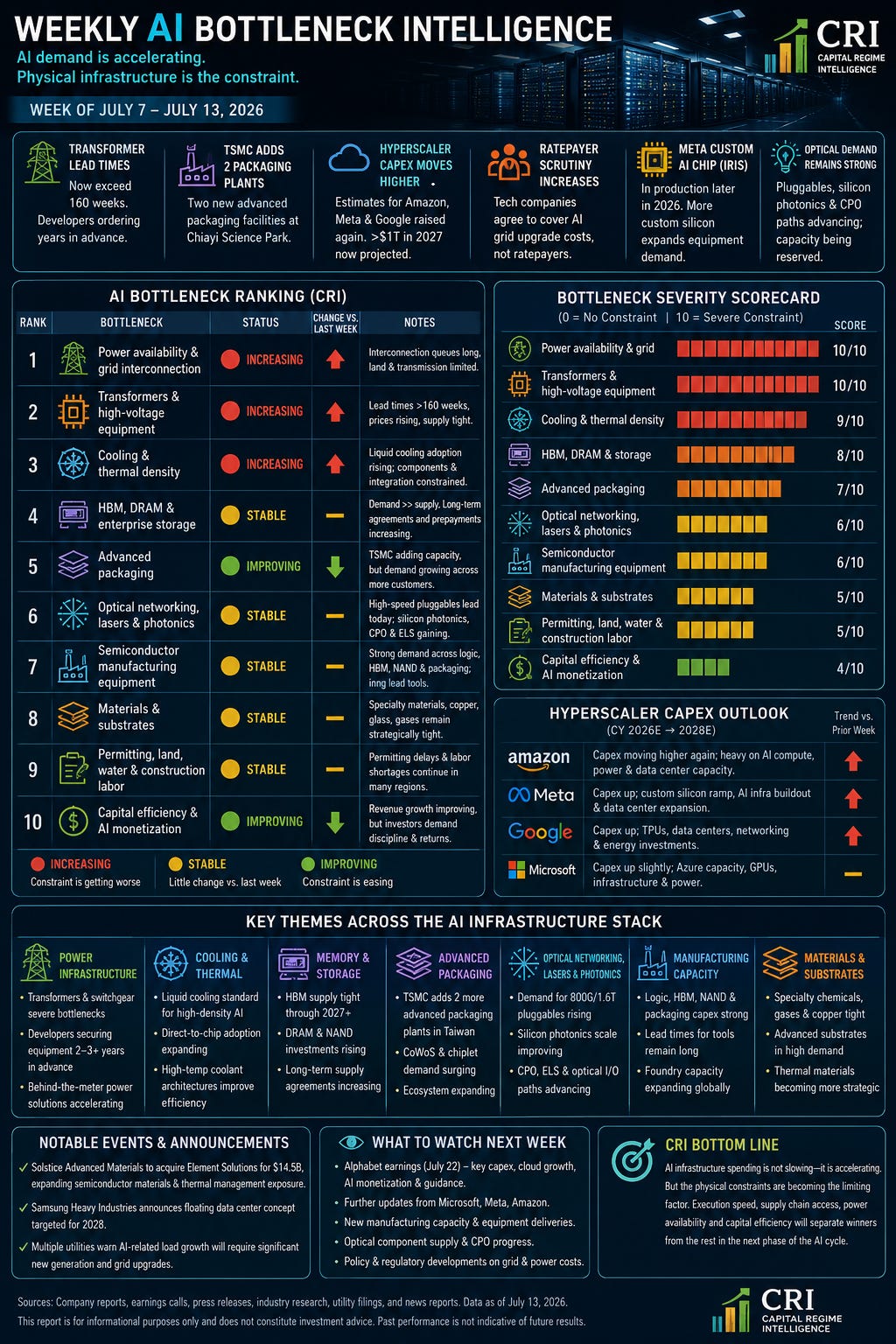
The AI infrastructure cycle entered another important phase this week.
Capital commitments continue to rise. Hyperscalers are expanding their internal chip programs. Advanced-packaging capacity is increasing. Memory manufacturers are building aggressively. Yet the physical systems required to turn those investments into functioning AI capacity remain increasingly strained.
The clearest signal came from the power layer.
Utilities and data-center developers are now ordering transformers and other critical electrical equipment years before projects are expected to come online. Some transformer lead times have reportedly extended beyond 160 weeks, while prices continue to rise.
This changes the nature of the AI bottleneck.
The limiting factor is no longer merely obtaining GPUs. It is securing the transformers, substations, switchgear, transmission access, cooling systems, memory, packaging capacity, optical connectivity and construction resources needed to deploy those GPUs.
At the same time, investors are beginning to question whether hyperscaler revenue growth can justify the enormous amount of capital now being committed.
That tension defines this week’s report:
AI infrastructure demand remains exceptionally strong, but the buildout is becoming more expensive, more politically sensitive and more difficult to execute.
Executive Read
The most important developments from the prior week were:
Power equipment became an even more visible bottleneck. Transformer shortages are forcing utilities and developers to reserve equipment several years in advance.
TSMC expanded its advanced-packaging plans. Two additional plants are being added in Taiwan as demand for CoWoS and other advanced-packaging technologies continues to grow.
Hyperscaler spending estimates moved higher again. Analysts increased projections for Amazon, Meta and Google as compute, memory and networking costs continue to rise.
The political risk surrounding AI electricity demand increased. Large technology companies are being pressured to ensure that data-center grid investments are not passed through to household ratepayers.
Semiconductor manufacturing equipment gained another demand catalyst. Meta’s internal AI-chip program reinforced expectations that custom silicon will expand the total market for wafer-fabrication equipment.
Optical networking remains structurally important, but there was no single architectural breakthrough this week. The market continues moving toward higher-speed pluggables, silicon photonics, external laser sources and eventually co-packaged optics.
This Week’s Bottleneck Ranking
1. Power availability and grid interconnection
Power remains the primary constraint because new generation alone does not solve the problem. Developers must also secure transmission access, substations, transformers, switchgear and interconnection approval.
2. Transformers and high-voltage electrical equipment
This category moved higher in importance. Equipment shortages are now capable of delaying otherwise fully financed data-center projects.
3. Cooling and thermal density
The move toward direct liquid cooling continues, but facility readiness, component availability and system integration remain uneven.
4. HBM, DRAM and enterprise storage
AI demand continues to pull memory capacity away from traditional markets. Long-term supply agreements and customer prepayments are becoming more common.
5. Advanced packaging
Capacity is expanding rapidly, but demand from GPUs, custom accelerators, networking silicon and HBM continues to grow alongside it.
6. Optical networking, lasers and photonics
Optics are becoming increasingly essential as clusters scale and electrical interconnects encounter limits in distance, bandwidth density and power consumption.
7. Semiconductor manufacturing equipment
Logic, HBM, NAND and packaging investments are increasing the number and complexity of deposition, etch, cleaning, inspection and metrology steps.
8. Materials and substrates
Advanced substrates, optical fiber, specialty glass, copper, chemicals, gases and thermal materials remain strategically important.
9. Permitting, land, water and construction labor
Infrastructure projects are encountering rising local opposition, longer timelines and greater scrutiny over water and electricity consumption.
10. Capital efficiency and AI monetization
Funding is available, but investors are increasingly demanding evidence that revenue and cash flow can support the scale of spending.
Power Infrastructure: The Bottleneck Inside the Bottleneck
Power has ranked near the top of the CRI bottleneck map for months, but this week provided an important refinement.
The problem is not simply a shortage of electricity.
It is increasingly a shortage of the physical equipment needed to deliver that electricity.
Transformers are especially difficult to scale. Large power transformers are customized, require specialized steel and copper, and must pass extensive qualification and testing. Manufacturing capacity cannot be added quickly.
Reports this week indicated that some transformer lead times have surpassed 160 weeks. Utilities and data-center developers are responding by:
Ordering equipment years in advance.
Signing longer-term supply agreements.
Making upfront payments to secure production slots.
Refurbishing older equipment.
Expanding their supplier bases.
Looking outside the United States for additional capacity.
This strongly favors established suppliers with qualified manufacturing capacity and customer relationships.
Companies to monitor include Eaton, Schneider Electric, GE Vernova, ABB, Siemens Energy, Hubbell, nVent, Powell Industries and Quanta Services.
The important investment distinction is that not every company exposed to data centers benefits equally.
The strongest positions belong to companies supplying components that are difficult to qualify, difficult to manufacture and essential to energizing a facility.
The Ratepayer Problem
The AI power buildout is also becoming politically sensitive.
Amazon, Google, Meta, Microsoft, OpenAI, Oracle and xAI have reportedly committed to cover the costs of certain AI-related generation and grid upgrades rather than shifting those expenses onto existing utility customers.
This is significant for two reasons.
First, it confirms that AI load growth is large enough to influence utility rate structures and public policy.
Second, it could change data-center economics. Hyperscalers may increasingly need to directly fund generation, transmission upgrades, storage and other infrastructure that utilities once absorbed more gradually.
The result could be even larger capital commitments but potentially faster project execution for the best-funded operators.
Hyperscaler Capex: Estimates Keep Moving Higher
Analysts continued raising spending estimates for Amazon, Meta and Google this week.
Morgan Stanley reportedly projected that cumulative cloud-provider AI infrastructure spending could approach $1.4 trillion by 2028. Other estimates suggest aggregate hyperscaler spending could exceed $1 trillion during 2027.
The exact forecasts will continue changing, but the direction is unmistakable.
AI infrastructure spending is still accelerating.
The cost increases are not limited to accelerators. Hyperscalers are paying more for:
HBM and conventional memory.
Networking silicon and optical components.
Power equipment.
Cooling systems.
Construction labor.
Land and grid access.
Custom silicon development.
Long-term data-center leases.
Backup generation and energy storage.
This creates an important divide.
Companies selling into unavoidable infrastructure constraints can earn revenue during the buildout. Hyperscalers must wait for AI services, cloud workloads and token generation to produce sufficient returns.
That is why the coming earnings cycle matters.
Alphabet is expected to begin the next major hyperscaler earnings test on July 22. Investors will focus on capex guidance, depreciation, AI revenue, cloud growth, free cash flow and management’s confidence in monetization.
The market may tolerate continued spending, but it will increasingly require evidence that demand is converting into profitable revenue.
Custom Silicon Expands the Manufacturing Opportunity
Meta’s reported plan to begin manufacturing its internal “Iris” AI chip later in 2026 provided another positive signal for semiconductor-equipment suppliers.
Custom accelerators do not necessarily reduce the overall semiconductor opportunity.
They may expand it.
Amazon, Google, Microsoft, Meta, Broadcom, Marvell and other companies are developing or supporting increasingly specialized compute architectures. Each new design requires foundry capacity, masks, deposition, etch, cleaning, inspection, testing and advanced packaging.
This benefits the semiconductor manufacturing ecosystem even as competition among chip designers increases.
Lam Research, Applied Materials and KLA reacted strongly to the Meta news because custom silicon adds another source of advanced-node and packaging demand.
For Lam Research specifically, the opportunity extends across:
Logic etch and deposition.
HBM and DRAM processing.
NAND scaling.
Through-silicon vias.
Advanced packaging.
Wafer cleaning.
Installed-base services.
The broader CRI read is that the AI semiconductor cycle is widening.
NVIDIA remains dominant, but growth in custom accelerators can increase total wafer-fabrication and packaging requirements rather than merely shifting share between chip designers.
Advanced Packaging: TSMC Adds More Capacity
TSMC is adding two more advanced-packaging facilities at the Chiayi Science Park in Taiwan.
The expansion will bring the planned total to four packaging facilities at that location. The first is reportedly already in mass production, with the second approaching production.
This is a constructive supply signal, but it should not be interpreted as evidence that the bottleneck has disappeared.
Demand is expanding across:
NVIDIA accelerators.
AMD accelerators.
Hyperscaler ASICs.
HBM integration.
Networking chips.
Chiplet-based processors.
Large interposer designs.
Advanced packaging is becoming more complex at the same time that volumes are increasing.
TSMC’s expansion should improve availability, but the industry could remain capacity-constrained because the addressable market is also growing.
The likely beneficiaries extend beyond TSMC.
Lam Research, Applied Materials, KLA, Onto Innovation, ASML, Tokyo Electron, Amkor, ASE and substrate suppliers all participate in various stages of advanced packaging and heterogeneous integration.
Memory: Supply Security Still Matters
AI memory demand remains structurally strong.
HBM receives the most attention, but the bottleneck extends into DRAM, NAND, enterprise SSDs and data-center storage. Training and inference systems require both extremely fast memory close to the accelerator and enormous storage capacity throughout the broader architecture.
Customers are responding by securing supply through longer-term agreements and direct capacity commitments.
The strategic shift is important.
Memory was historically purchased through a highly cyclical market. AI customers are increasingly treating access to memory as an infrastructure requirement.
That supports stronger pricing, greater revenue visibility and larger investment programs for Micron, SK Hynix and Samsung.
The risk is that capacity eventually overshoots demand. However, current behavior suggests large customers remain more concerned about securing enough supply than about creating excess inventory.
Optical Networking, Lasers and Photonics
The optical bottleneck did not produce a single dominant announcement this week, but the structural direction remains unchanged.
AI cluster performance is increasingly determined by the ability to move data between:
Accelerators.
Racks.
Switches.
Memory pools.
Storage systems.
Separate data halls and campuses.
Copper remains effective at shorter distances, but its power consumption and signal-integrity challenges increase as speed and reach expand.
The competing optical paths include:
Higher-speed pluggable optics
These remain the near-term volume architecture and benefit established transceiver, laser, DSP and component suppliers.
Silicon photonics
Silicon photonics improves integration and can lower power and cost at scale. Broadcom, Marvell, Intel, Cisco and multiple private companies are pursuing this path.
Co-packaged optics
CPO brings optical engines closer to switch or compute silicon. It offers potential improvements in bandwidth density and power efficiency but introduces manufacturing, thermal, serviceability and yield challenges.
External light sources
Separating the laser from the optical engine can improve thermal management and serviceability. Coherent, Lumentum, POET Technologies and other companies are developing related technologies.
Optical I/O
Companies such as Ayar Labs seek to move optics directly into package-level compute connectivity.
Optical circuit switching
This architecture may reduce electrical switching requirements for certain large-scale AI workloads but remains earlier in commercialization.
No single architecture has won.
CRI continues to expect multiple technologies to coexist, with pluggables remaining dominant in the near term while silicon photonics, external lasers and CPO gain adoption in specific applications.
Key public companies to monitor include Broadcom, Marvell, Coherent, Lumentum, Ciena, Arista, Cisco, Corning and POET Technologies.
Optical Manufacturing Capacity Is Becoming Strategic
Earlier agreements between NVIDIA and Coherent, Lumentum and Corning remain important context for this week’s bottleneck map.
Those agreements included manufacturing expansion, purchase commitments, research collaboration and capacity access.
The message is clear:
Leading AI companies are no longer assuming that sufficient optical supply will simply be available.
They are securing it.
This behavior resembles what occurred with HBM and advanced packaging. Once an input becomes essential and difficult to scale, customers begin using long-term contracts, investments and strategic partnerships to reserve capacity.
That strengthens the position of suppliers with:
Proven laser technology.
Qualified manufacturing.
Materials expertise.
High-volume packaging capabilities.
Reliable yields.
Deep hyperscaler relationships.
Smaller photonics companies may offer differentiated technology, but they must demonstrate that it can be manufactured reliably at customer-required volumes.
Cooling: Architecture Is Advancing Faster Than Deployment
Liquid cooling continues moving from an optional feature to a system requirement.
NVIDIA’s recent Rubin cooling design supports coolant temperatures as high as approximately 45 degrees Celsius. Higher coolant temperatures can reduce reliance on energy-intensive chillers and may allow closed-loop systems to reject heat through outdoor dry coolers.
The potential benefits include:
Lower facility energy consumption.
Reduced evaporative water use.
Simpler heat rejection in suitable climates.
Higher rack density.
Better alignment between chip, rack and facility design.
However, the market should distinguish between reference architecture and widespread installed capacity.
Data centers still need:
Coolant distribution units.
Pumps.
Cold plates.
Manifolds.
Leak detection.
Controls.
Heat exchangers.
Qualified fluids.
Maintenance procedures.
Facility retrofits.
This favors companies capable of integrating cooling with power, controls and service.
Vertiv and Schneider Electric remain the most complete public-company exposures. Modine, nVent, Johnson Controls, Carrier and specialized private suppliers also participate in portions of the thermal stack.
Competing Infrastructure Technologies
Several technology battles are becoming increasingly important.
AC Versus Higher-Voltage DC Power Distribution
Traditional data-center power architectures are being challenged by rising rack power requirements. Higher-voltage DC distribution could reduce conversion losses and conductor requirements, but standards, safety, equipment compatibility and installed infrastructure remain obstacles.
Grid Power Versus Behind-the-Meter Generation
Developers are evaluating natural gas, fuel cells, nuclear power, renewables, storage and microgrids to reduce dependence on constrained utility interconnections.
The likely outcome is not one winner. Large AI campuses will increasingly combine multiple energy sources.
Air Cooling Versus Direct Liquid Cooling
Air cooling will remain useful for lower-density workloads, but direct liquid cooling is becoming the preferred path for the highest-density AI systems.
Land-Based Versus Alternative Data Centers
Samsung Heavy Industries announced plans for floating data-center infrastructure targeted for 2028. Floating systems could use seawater for heat rejection and avoid some land constraints, but corrosion, reliability, connectivity and marine maintenance remain significant challenges.
This is not yet a mainstream solution, but it illustrates the lengths the industry is exploring to solve land, water, cooling and permitting constraints.
Bottleneck Map
Worsening
Transformers and electrical-equipment availability
Lead times and prices remain elevated, with AI demand adding pressure to an already constrained supply chain.
Capital intensity
The cost of building each gigawatt of AI capacity is rising as chips, memory, networking and infrastructure expenses increase.
Political and ratepayer scrutiny
Local communities and regulators increasingly want hyperscalers to directly fund the grid costs created by their projects.
Still Highly Constrained
Power and interconnection
Access to reliable power remains the primary determinant of project timing.
HBM and advanced memory
Capacity is growing, but demand remains strong enough to support long-term agreements.
Advanced packaging
TSMC is adding capacity, yet demand is expanding across more customers and architectures.
Liquid-cooling deployment
The technology is advancing, but facility conversion and supply-chain readiness remain uneven.
High-performance optical components
Customers are reserving laser, fiber and photonics capacity through strategic agreements.
Improving
Advanced-packaging construction
TSMC and other suppliers are adding meaningful capacity.
Custom silicon availability
More hyperscalers are developing internal accelerators, reducing exclusive reliance on a single compute architecture.
Cooling technology
Higher-temperature closed-loop systems and direct-to-chip solutions are improving facility efficiency.
Optical manufacturing investment
Major strategic agreements are increasing capacity across fiber, lasers and optical components.
Earnings and Guidance Watch
The prior week did not include a full hyperscaler earnings cycle, so the most important earnings signals remain ahead.
The next major tests will focus on:
Alphabet
Capex growth, Google Cloud revenue, AI monetization and free cash flow.
Microsoft
Azure AI demand, capacity constraints, depreciation and infrastructure commitments.
Meta
AI engagement, advertising returns, custom silicon progress and capex guidance.
Amazon
AWS growth, Trainium deployment, power availability and data-center investment.
Semiconductor equipment
Watch Lam Research, Applied Materials and KLA for updated wafer-fabrication-equipment expectations, HBM spending and advanced-packaging demand.
Optical suppliers
Watch Coherent, Lumentum, Marvell and Broadcom for capacity, laser supply, transceiver demand and silicon-photonics commentary.
CRI Investment Read
The AI infrastructure cycle remains powerful, but the market is entering a more selective phase.
Investors are increasingly separating companies into three groups.
Companies Selling Into Immediate Constraints
These companies generate revenue as hyperscalers build infrastructure.
Examples include power equipment, cooling, memory, optical components, packaging and semiconductor manufacturing tools.
Companies Funding the Buildout
Hyperscalers are absorbing the capital burden and must ultimately prove that AI revenue justifies the spending.
Companies Offering Emerging Technology Without Proven Scale
These companies may possess compelling technology, but they must still complete qualification, manufacturing ramp and customer conversion.
The first group currently offers the clearest revenue visibility.
Within that group, CRI continues to favor businesses with manufacturing barriers, long qualification cycles, high switching costs and strategic customer relationships.
Companies to Monitor
Power and Electrical
Vertiv, Eaton, Schneider Electric, GE Vernova, ABB, Siemens Energy, Powell Industries, Hubbell, nVent and Quanta Services.
Cooling
Vertiv, Schneider Electric, Modine, nVent, Johnson Controls and Carrier.
Memory and Storage
Micron, SK Hynix, Samsung, SanDisk and Western Digital.
Advanced Packaging and Manufacturing
TSMC, Lam Research, Applied Materials, KLA, ASML, Onto Innovation, Amkor and ASE.
Optical Networking and Photonics
Broadcom, Marvell, Coherent, Lumentum, Ciena, Arista, Corning, Cisco and POET Technologies.
Hyperscalers
Microsoft, Amazon, Alphabet, Meta, Oracle and the expanding neocloud ecosystem.
CRI Bottom Line
The AI infrastructure cycle is not slowing.
It is becoming harder to build.
This week’s evidence shows that the limiting factors are moving farther away from chip design and deeper into the physical supply chain.
Transformers must be ordered years ahead.
Hyperscalers may need to directly fund grid upgrades.
Advanced-packaging plants must be constructed at enormous scale.
Memory capacity is being secured through long-term agreements.
Optical suppliers are receiving strategic investments and purchase commitments.
Cooling is being redesigned around the chip and rack.
The next stage of the AI cycle will not be determined only by who develops the most powerful accelerator.
It will be determined by who can assemble the entire infrastructure stack—and who can do it before power, equipment, costs and public resistance slow the deployment.
The AI supercycle remains intact. The bottleneck is execution.