Weekly AI Bottleneck Intelligence
Manufacturing Capacity Is Accelerating—But Power, Permitting and Capital Efficiency Are Becoming Harder Constraints

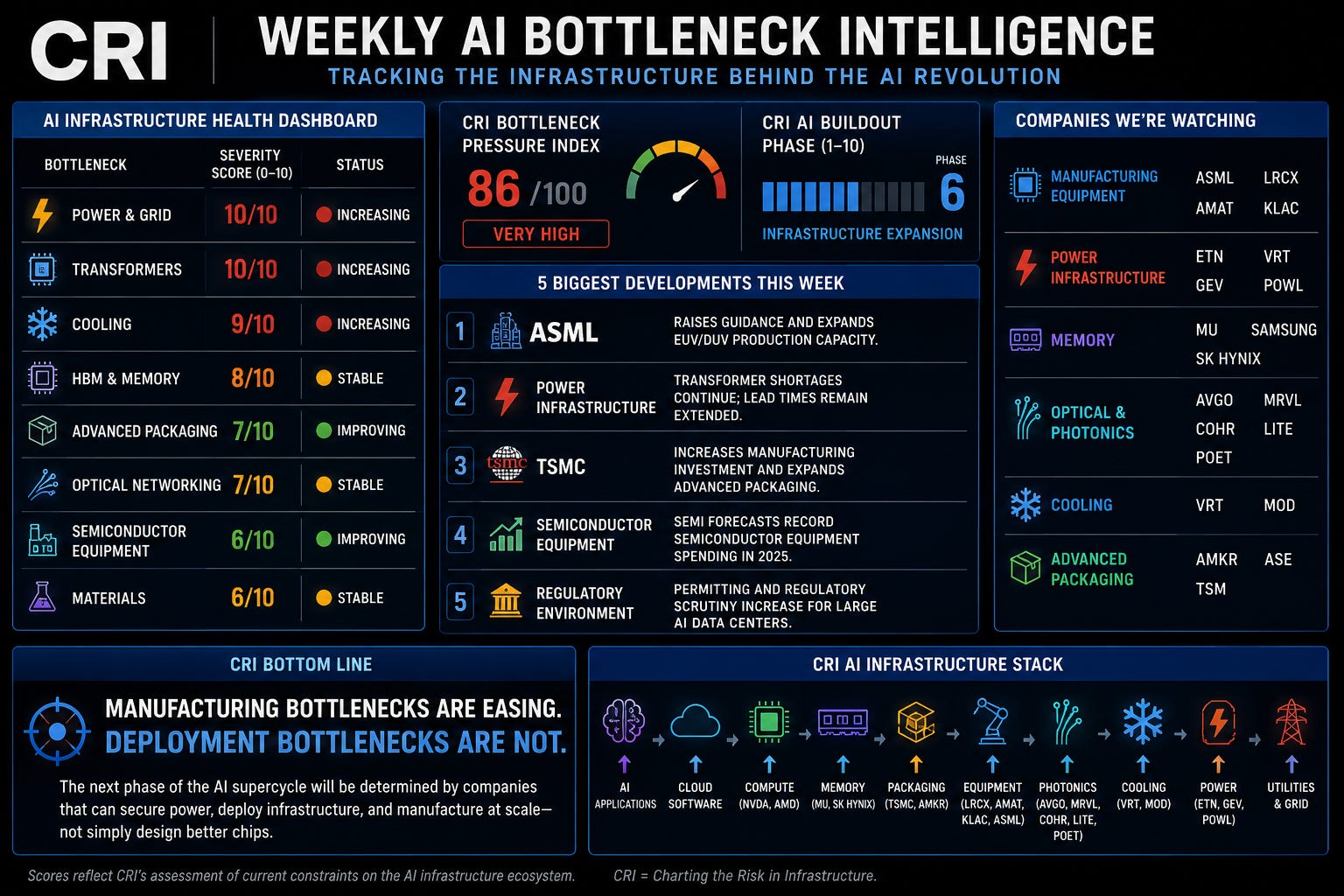
The AI infrastructure cycle delivered an important split signal this week.
On one side, semiconductor manufacturers and equipment suppliers are responding aggressively to demand. ASML raised its outlook and announced plans to expand lithography-system capacity. TSMC increased its capital-spending expectations and outlined another major manufacturing expansion. Industry forecasts for semiconductor-equipment spending moved materially higher.
On the other side, the physical deployment environment became more difficult.
Large AI data-center campuses are securing multibillion-dollar leases years before completion. Governments and communities are imposing new restrictions on projects because of power, water and ratepayer concerns. Investors are beginning to question how long hyperscaler capital spending can grow at its current pace.
This creates the central tension in this week’s report:
The semiconductor supply chain is scaling faster, but the data-center deployment chain remains constrained by electricity, permitting, construction timelines and capital intensity.
The AI supercycle remains intact.
However, the next phase will increasingly reward companies that can convert capital into operational capacity—not merely announce ambitious spending plans.
Executive Read
The most important development this week came from the semiconductor-manufacturing layer.
ASML reported stronger-than-expected second-quarter results, raised its full-year outlook and announced plans to increase production capacity for both low-NA EUV and DUV immersion systems by approximately 30% in 2027.
This is significant because ASML’s tools sit near the beginning of nearly every advanced AI chip supply chain.
More lithography capacity ultimately supports greater production of:
Leading-edge logic
HBM and advanced DRAM
Custom AI accelerators
Networking silicon
Advanced processors
Semiconductor packaging components
The broader equipment cycle also strengthened. SEMI now expects global semiconductor-manufacturing equipment sales to reach approximately $165.9 billion in 2026, increasing more than 23% from the prior year.
This strongly supports the CRI thesis that AI demand is moving deeper into the manufacturing stack.
At the same time, power and site access remain the leading data-center bottlenecks.
Hut 8 signed another long-term lease covering 352 megawatts of IT capacity at its Beacon Point campus in Texas. The agreement fully commercializes the one-gigawatt site and demonstrates how valuable energized or power-secured campuses have become.
The company does not need to manufacture GPUs or develop AI models to create strategic value.
It controls something increasingly scarce:
A large site with credible access to power and a path toward deployment.
The regulatory environment also became more difficult. New York moved to pause large new data-center projects while authorities in several other regions continue evaluating restrictions tied to electricity use, water demand, land availability and consumer power prices.
The AI buildout is therefore becoming geographically selective.
Projects will increasingly flow toward regions that can provide:
Reliable power
Faster interconnections
Supportive permitting
Water or low-water cooling alternatives
Skilled construction labor
Acceptable community economics
CRI Bottleneck Ranking
1. Power Availability and Grid Interconnection
Status: Increasing constraint
Severity: 10/10
Power remains the primary bottleneck.
The problem is not simply producing enough electricity. A functioning AI campus also requires transmission access, substations, transformers, breakers, switchgear, backup generation and interconnection approval.
Developers are increasingly securing power years before a data center becomes operational.
The Hut 8 agreement is a clear example. The value of the Beacon Point campus comes from the combination of land, utility supply, design readiness and the ability to support hundreds of megawatts of AI compute.
This is why powered land is becoming a distinct AI infrastructure asset class.
2. Transformers and High-Voltage Electrical Equipment
Status: Increasing constraint
Severity: 10/10
Transformer lead times remain severe.
Utilities and developers are placing orders years in advance, making upfront payments and expanding supplier relationships to secure delivery slots.
This favors established manufacturers with:
Qualified products
Existing production capacity
Long customer relationships
Proven reliability
Service and maintenance networks
Eaton, Schneider Electric, GE Vernova, ABB, Siemens Energy, Hubbell, Powell Industries and nVent remain central companies to monitor.
The electrical-equipment bottleneck is especially durable because new manufacturing capacity takes time to qualify and ramp.
3. Permitting, Land and Community Approval
Status: Worsening
Severity: 9/10
Permitting moved meaningfully higher in this week’s ranking.
Data-center projects are encountering more scrutiny over:
Household electricity prices
Water consumption
Noise
Backup generation
Land use
Tax incentives
Local employment
Environmental impact
New York’s pause on large projects reflects a wider shift.
Communities are no longer automatically accepting the argument that a large data center is economically beneficial. They increasingly want guarantees that developers will fund infrastructure upgrades, protect ratepayers and provide meaningful local benefits.
This could create substantial differences between jurisdictions.
Supportive states may gain projects, investment and tax revenue, while restrictive regions may push development toward other power markets.
4. Cooling and Thermal Density
Status: Increasing constraint
Severity: 9/10
AI rack density continues rising faster than traditional cooling infrastructure can adapt.
Direct-to-chip liquid cooling is becoming the standard for the highest-density AI systems, but deployment remains constrained by:
Coolant distribution units
Cold plates
Pumps and manifolds
Leak detection
Heat exchangers
Qualified fluids
Controls and monitoring
Facility retrofits
Skilled service personnel
The technology is available.
The bottleneck is implementing complete, reliable thermal systems across thousands of racks.
Vertiv and Schneider Electric remain the most complete public-company exposures because both can integrate power, cooling, controls and services.
Modine, nVent, Johnson Controls, Carrier and specialized private suppliers participate in individual parts of the thermal architecture.
5. HBM, DRAM and Enterprise Storage
Status: Tight but stable
Severity: 8/10
Memory remains one of the strongest structural AI-demand layers.
HBM receives the most attention because it sits directly beside accelerators, but the broader requirement also includes conventional DRAM, NAND and enterprise SSDs.
More AI compute creates demand throughout the storage hierarchy.
Memory customers are increasingly using long-term agreements, prepayments and capacity reservations to secure supply.
This changes the nature of the memory cycle.
Historically, memory was largely treated as a commodity purchased when required. AI infrastructure operators increasingly treat assured access to memory as a strategic necessity.
Micron, SK Hynix and Samsung remain the principal beneficiaries.
The key risk is eventual overcapacity, but current investment behavior still suggests customers are more concerned about shortages than excess supply.
6. Advanced Packaging
Status: Improving slowly
Severity: 7/10
Advanced packaging remains constrained, but capacity expansion is becoming visible.
TSMC continues increasing spending and expanding manufacturing plans across leading-edge process technologies and packaging.
The packaging opportunity is broadening beyond one architecture.
AI systems increasingly require:
CoWoS
Large interposers
Chiplets
Through-silicon vias
Hybrid bonding
Wafer-level packaging
Panel-level packaging
Advanced substrates
Demand comes from NVIDIA, AMD, hyperscaler ASICs, networking processors and HBM.
Additional capacity should narrow the supply gap, but it may not create excess supply because package size, complexity and volume are all rising simultaneously.
The constraint is easing—not disappearing.
7. Optical Networking, Lasers and Photonics
Status: Tight but stable
Severity: 7/10
The prior week did not produce one dominant optical announcement, but the underlying trend remains strong.
As AI systems scale, data movement increasingly limits performance.
The industry continues developing several competing and complementary architectures:
800G and 1.6T pluggable optics
Silicon photonics
Co-packaged optics
External light sources
Optical I/O
Optical circuit switching
Linear-drive optics
Pluggable optical modules remain the near-term volume solution because they are familiar, replaceable and supported by an established manufacturing ecosystem.
Co-packaged optics offers potential advantages in power efficiency and bandwidth density but introduces difficult challenges involving yield, thermal management, repairability and system qualification.
External light sources separate the laser from the optical engine, potentially improving serviceability and thermal stability.
Optical I/O brings photonic connectivity closer to processors and memory but remains earlier in commercialization.
No single technology has won.
CRI continues to expect multiple optical paths to coexist, with adoption determined by reach, power, bandwidth, cost, manufacturability and serviceability.
Companies to monitor include Broadcom, Marvell, Coherent, Lumentum, Ciena, Arista, Cisco, Corning and POET Technologies.
8. Semiconductor Manufacturing Equipment
Status: Improving capacity, accelerating demand
Severity: 6/10
The semiconductor-equipment layer produced the strongest positive signal of the week.
ASML reported second-quarter revenue of €9.3 billion and raised its 2026 revenue outlook to between €43 billion and €45 billion.
Management also plans to expand 2027 production capacity by approximately 30% for low-NA EUV systems and 30% for DUV immersion systems.
This matters far beyond ASML.
Lithography capacity supports additional wafer output, which creates demand for:
Lam Research etch and deposition systems
Applied Materials process tools
KLA inspection and metrology
Tokyo Electron coating, cleaning and etch equipment
Onto Innovation packaging inspection
Advanced test and assembly equipment
SEMI’s new forecast reinforces the trend.
Global semiconductor-equipment sales are now projected to reach a record $165.9 billion in 2026, including approximately $143.9 billion of wafer-fabrication equipment.
AI is not simply driving more wafer starts.
It is increasing the number and complexity of process steps required for each wafer.
That creates a powerful combination:
More wafers and more equipment intensity per wafer.
9. Materials and Substrates
Status: Tight but stable
Severity: 6/10
The AI manufacturing buildout remains dependent on a broad collection of materials that receive less investor attention.
These include:
High-purity chemicals
Specialty gases
Copper
Optical fiber
Gallium arsenide and indium phosphide
Silicon photonics wafers
Advanced organic substrates
Glass substrates
Thermal interface materials
Coolants
Precision ceramics
As packages become larger and more complex, substrate warpage, thermal expansion and signal integrity become harder to manage.
Glass substrates remain a longer-term technology path because they can provide better dimensional stability and support higher interconnect density. However, broad adoption will depend on cost, equipment availability, yield and ecosystem readiness.
Materials will rarely receive the same attention as GPUs, but they can become critical constraints because substitution and qualification are difficult.
10. Capital Efficiency and AI Monetization
Status: Increasing concern
Severity: 6/10
Capital efficiency is becoming the financial bottleneck inside the AI buildout.
Hyperscaler spending is still rising, but analysts increasingly expect the growth rate to moderate after the current investment surge.
This does not mean capital expenditures must decline.
It means investors will increasingly examine how much usable AI capacity each dollar creates.
That distinction is becoming more important because infrastructure costs are rising across:
Memory
Power equipment
Construction labor
Cooling
Networking
Land
Energy
Advanced chips
A higher capital-spending number is not automatically bullish if the increase reflects cost inflation rather than additional deployed capacity.
Investors should watch for operating metrics such as:
Megawatts energized
GPU clusters deployed
Cloud capacity added
AI revenue growth
Utilization
Customer prepayments
Remaining performance obligations
Free-cash-flow conversion
ASML Earnings: A Major Confirmation Signal
ASML provided one of the clearest confirmations that AI-related semiconductor demand remains strong.
The company’s second-quarter revenue exceeded expectations, while installed-base management revenue benefited from strong upgrade activity.
More importantly, management stated that AI-related investment is driving demand for both advanced logic and memory chips.
ASML’s capacity plans are particularly important.
The company expects to increase low-NA EUV capacity from roughly 65 systems in 2026 by approximately 30% in 2027. It is considering another similar increase in 2028.
DUV immersion capacity is expected to follow a comparable path.
This suggests customers are making commitments far enough into the future for ASML to justify substantial manufacturing expansion.
The read-through is positive for:
TSMC
Samsung
Intel Foundry
Micron
SK Hynix
Lam Research
Applied Materials
KLA
Tokyo Electron
The lithography bottleneck is beginning to improve, but demand is also rising quickly enough to absorb the new supply.
TSMC: Manufacturing Leadership Becomes More Expensive
TSMC continues reinforcing its position as the central manufacturing platform for advanced AI semiconductors.
The company reportedly raised its 2026 capital-spending outlook and outlined another substantial U.S. investment that could include additional leading-edge fabs and advanced-packaging facilities.
The expansion supports several strategic objectives:
Greater leading-edge wafer capacity
More geographic manufacturing diversity
Domestic production for U.S. customers
Expanded packaging capability
Reduced dependence on a single region
However, manufacturing outside Taiwan generally carries higher costs.
TSMC must manage:
Construction expenses
Labor availability
Supplier localization
Water access
Power availability
Equipment installation
Process matching
Yield consistency
TSMC possesses the financial strength and process expertise to manage these challenges better than most competitors, but geographic diversification is not free.
The company’s scale advantage remains enormous.
Its ability to combine advanced process nodes with packaging, customer support and ecosystem depth makes it difficult for competitors to displace.
Powered Data-Center Campuses Become Strategic Assets
Hut 8’s latest lease demonstrates how the AI infrastructure market is assigning value to large, power-secured sites.
The company’s Beacon Point campus now has commitments covering its full one-gigawatt capacity.
The new lease adds 352 megawatts of IT capacity and is expected to begin delivering capacity in 2028.
This provides several important signals.
First, customers are willing to sign exceptionally long contracts years before delivery.
Second, reliable access to power is valuable enough to support multibillion-dollar commitments.
Third, former cryptocurrency miners and energy-intensive computing operators are becoming credible AI-infrastructure developers because they already understand power procurement, large electrical loads and campus operations.
The category remains capital intensive and carries financing, construction and customer-concentration risk.
However, operators with genuine power access and investment-grade tenants may occupy an increasingly strategic position.
Hyperscaler Capex: Growth May Slow Without Reversing
A Reuters analysis this week highlighted the possibility that hyperscaler capital-spending growth will decelerate after 2026.
That distinction matters.
A reduction in the growth rate is not the same as a reduction in spending.
After an extraordinary expansion, capital expenditures can continue rising while year-over-year growth moderates.
The market may react negatively if it interprets slower growth as the end of the AI cycle.
CRI believes the more important questions are:
Is absolute spending still increasing?
Are AI backlogs still expanding?
Is capacity still constrained?
Are customers prepaying for infrastructure?
Are equipment orders being cancelled?
Are memory and packaging investments being reduced?
Unless those underlying indicators deteriorate, slower capex growth may represent normalization rather than collapse.
The upcoming hyperscaler earnings cycle will provide the next major test.
Competing Technologies to Watch
Low-NA EUV Versus High-NA EUV
Low-NA EUV remains the established path for leading-edge production.
High-NA EUV promises greater resolution and fewer patterning steps but carries significantly higher tool, facility and process costs.
Intel has been an early adopter. TSMC and other manufacturers may take a more selective approach until economics and throughput improve.
Lam Research’s dry-resist technology and advanced patterning tools can become important across either path because customers still require better materials, deposition and etch control.
Pluggable Optics Versus Co-Packaged Optics
Pluggables remain dominant because of serviceability and ecosystem maturity.
CPO may gain share where bandwidth density and power efficiency become more important than easy component replacement.
The likely outcome is gradual coexistence rather than immediate replacement.
Grid Power Versus Behind-the-Meter Generation
Grid connections remain the preferred option where capacity is available.
Where interconnection queues are too long, developers are increasingly evaluating natural gas generation, fuel cells, batteries, renewables and microgrids.
Behind-the-meter power may accelerate deployment but introduces fuel, emissions, permitting and operational risks.
Air Cooling Versus Direct Liquid Cooling
Air cooling will remain relevant for lower-density systems.
Direct liquid cooling is becoming necessary for the highest-density AI racks.
Hybrid facilities will likely operate both architectures for years.
Traditional Data Centers Versus Grid-Interactive Compute
A developing alternative is to make AI workloads more responsive to electricity-system conditions.
Training jobs may be shifted geographically or temporarily reduced during grid stress. This could improve utilization of existing infrastructure and shorten interconnection delays.
Grid-responsive compute will not eliminate the need for more power, but it may increase the amount of AI capacity supported by existing systems.
Bottleneck Map
Worsening
Power access and interconnection
Demand for large, contiguous power blocks continues to exceed near-term availability.
Permitting and community approval
Governments are placing greater restrictions on large data-center developments.
Capital efficiency
Higher costs are reducing the amount of deployable capacity received for each dollar of spending.
Cooling-system integration
Component production and facility retrofits are struggling to keep pace with rising rack density.
Still Highly Constrained
Transformers and switchgear
Lead times remain measured in years for some equipment categories.
HBM and advanced memory
Capacity expansion continues, but AI demand remains strong.
Optical components
High-speed lasers, DSPs, fiber and modules require further manufacturing investment.
Advanced packaging
Supply is improving, but package complexity and demand are expanding.
Improving
Lithography capacity
ASML is planning substantial EUV and DUV production increases.
Wafer-fabrication equipment availability
Manufacturers are investing aggressively across the equipment ecosystem.
Leading-edge foundry capacity
TSMC and competitors continue expanding advanced-node production.
Advanced-packaging construction
New facilities are being announced and commissioned globally.
CRI Investment Read
This week strengthens the case for investing across the manufacturing and infrastructure layers rather than concentrating solely on accelerator designers.
The strongest confirmations came from:
ASML’s higher guidance
ASML’s capacity-expansion plans
SEMI’s record equipment forecast
TSMC’s increased manufacturing commitments
Long-term leasing of power-secured AI campuses
The principal risks came from:
Regulatory restrictions
Electricity shortages
Transformer lead times
Rising project costs
Capex-return scrutiny
Slower future spending growth
This creates a more selective market.
Companies with scarce manufacturing capacity, established qualification histories and essential technology should remain better positioned than companies relying primarily on projected future demand.
Companies to Monitor
Semiconductor Manufacturing
ASML, Lam Research, Applied Materials, KLA, Tokyo Electron, Onto Innovation and TSMC.
Memory and Storage
Micron, SK Hynix, Samsung, Western Digital and SanDisk.
Power and Electrical Infrastructure
Eaton, Schneider Electric, GE Vernova, ABB, Siemens Energy, Hubbell, nVent, Powell Industries and Quanta Services.
Cooling and Thermal Management
Vertiv, Schneider Electric, Modine, nVent, Johnson Controls and Carrier.
Optical Networking and Photonics
Broadcom, Marvell, Coherent, Lumentum, Ciena, Arista, Corning, Cisco and POET Technologies.
Data-Center Developers
Hut 8, IREN, CoreWeave, Applied Digital, Equinix, Digital Realty and selected power-secured campus developers.
What We Are Watching Next
The upcoming hyperscaler earnings cycle should provide the next major test of the AI infrastructure thesis.
CRI will focus on five questions:
Are capital-spending plans still increasing in absolute dollars?
How much of higher capex represents additional capacity versus inflation?
Are power constraints delaying customer deployments?
Is AI revenue growing fast enough to support depreciation and financing costs?
Are customers signing long-term agreements or providing prepayments to secure capacity?
We will also watch Lam Research and other semiconductor-equipment companies for confirmation that the strength reported by ASML is extending across deposition, etch, inspection and packaging.
CRI Bottom Line
The AI infrastructure buildout did not weaken this week.
It became more uneven.
Semiconductor manufacturing capacity is expanding aggressively. Equipment suppliers are raising forecasts. Foundries are committing enormous capital. Powered campuses are attracting multibillion-dollar contracts.
But power, permitting, cooling and capital efficiency remain formidable constraints.
The manufacturing bottleneck is beginning to ease.
The deployment bottleneck is not.
That distinction will define the next phase of the AI market.
The companies most likely to lead are those that can do more than announce capacity.
They must secure power, obtain permits, acquire equipment, maintain yields, control costs and deliver operational infrastructure on time.
The AI supercycle remains intact. Execution is becoming the scarce asset.